
Choosing the right rollstock film is rarely about finding one “best” material. In real packaging projects, the better question is which structure fits the product, the filling process, the shelf-life target, and the final pack style. A film that works well for dry snacks may not be the right choice for coffee, frozen food, powders, or household products.
That is why rollstock film is usually built as a functional structure rather than a single material. Different layers contribute different properties, such as printability, stiffness, seal strength, puncture resistance, and barrier protection. The right combination depends on what the pack needs to do in actual production and in real distribution conditions.
What material selection really depends on
When brands review rollstock film options, the material decision usually comes down to a few practical questions. It is not only about the film itself, but also about how the product behaves, how the package will be used, and how the material needs to perform during production and distribution.
If you are reviewing options for a live packaging project, our rollstock film page also outlines common converting, printing, and packaging applications in more detail.
- Product sensitivity: Some products mainly need moisture protection, while others are more sensitive to oxygen, aroma loss, grease, or light exposure.
- Shelf-life target: A short-turn retail product and a long-distribution export product may need very different barrier levels.
- Packaging process: Film must run smoothly on the intended machine, seal consistently, and suit the forming method.
- Pack presentation: Matte, gloss, transparency, metallic appearance, and print finish all influence material choice.
- Cost and sustainability goals: Some projects prioritize maximum protection, while others look for a more simplified or recyclable-ready structure where possible.
Common rollstock film layers and what they do
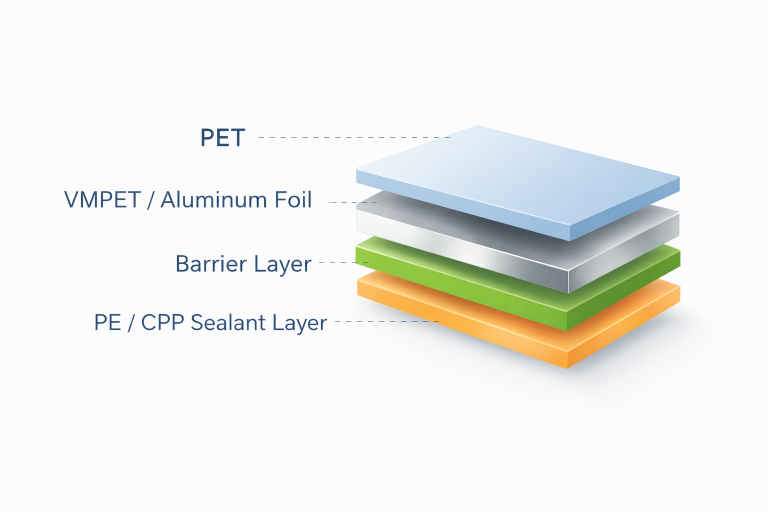
Most custom rollstock films are built as layered structures rather than single-material films. Each layer contributes a different function, such as print quality, stiffness, seal performance, toughness, or barrier protection. The final structure is usually selected by balancing product needs, machine performance, cost, and visual presentation.
Aluminum Foil
Foil structures are commonly selected for products that need a higher level of protection from light, oxygen, and moisture. They are often used for more sensitive or shelf-life-critical products.
VMPET
VMPET adds stronger barrier performance than standard clear films and is often used when better protection against oxygen and moisture is needed without moving directly to foil.
PET
Often used as the outer layer, PET offers good printability, stiffness, and dimensional stability. It helps support clean graphics and stable film performance during converting and packaging.
BOPP
BOPP is commonly used when clarity, gloss, and shelf appeal matter. It is often seen in snack and dry-food packaging where appearance and efficient production are both important.
PE / CPP
PE or CPP is often used as the sealant layer. This part of the structure is important for reliable heat sealing, pack integrity, and overall running performance on the filling line.
NY / PA
Nylon, also referred to as PA, is often chosen when extra toughness and puncture resistance are needed. It can help improve pack durability for more demanding applications.
Material suggestions for different packaging needs
Different products do not need the same film structure. In practice, material selection usually starts with what the product needs to resist, how long it needs to remain stable, and how the pack will run on the machine. The examples below show how material priorities can shift across different packaging applications.
In many cases, the selected film is later converted into finished formats such as flat pouch packaging, where seal consistency, barrier balance, and visual presentation all need to work together.
Dry snacks and confectionery
For many snack applications, the structure is often selected for print appearance, sealing consistency, and a practical level of moisture protection. Depending on the product and shelf-life target, BOPP-based or PET-based laminations are often considered.
Powders, drink mixes, and supplements
Powder products usually need dependable seal integrity and stable barrier performance, especially when the fill is fine, dusty, or moisture-sensitive. As shelf-life or sensitivity increases, higher-barrier structures are often reviewed more carefully.
Coffee and aroma-sensitive products
Coffee often needs stronger aroma retention and oxygen protection than standard dry goods. In these projects, higher-barrier material structures are commonly preferred to help preserve product freshness and overall pack performance.
Frozen and refrigerated products
Cold-chain packaging often puts more focus on seal reliability, film toughness, and handling strength. Material selection may need to support colder storage conditions, transport stress, and a lower risk of puncture or seal failure.
A practical checklist before finalizing rollstock film
Before confirming a rollstock film structure, it helps to step back and review the full packaging job. In many cases, the best solution is not simply the highest barrier or the most complex lamination. The better choice is the structure that protects the product well, runs consistently on the machine, supports the desired pack appearance, and stays realistic for the project budget.
Product behavior
Start with the product itself. Moisture, oxygen, aroma, grease, light exposure, and puncture risk can all affect the structure choice. Even products in the same category may need different film priorities depending on ingredients and storage conditions.
Packing line requirements
A good film structure must also work well on the intended machine. Forming style, sealing temperature window, running speed, and overall line stability all matter. A structure that looks good on paper still needs to perform reliably in actual production.
Shelf life and distribution
Expected shelf life should be reviewed together with transport and storage conditions. A product packed for local short-cycle sales may not need the same barrier level as one shipped across regions or stored for a longer period. Distribution reality often changes the material decision.
Appearance, cost, and sustainability
Material choice is also influenced by finish, print quality, transparency, metallic effect, and overall pack feel. At the same time, cost targets and sustainability goals may push the structure toward a simpler or more recyclable-ready direction. The final decision is usually a balance, not a single-factor choice.
Frequently asked questions about rollstock film materials
Below are a few common questions brands ask when comparing rollstock film structures for different packaging applications.
Rollstock film is supplied on a roll and used on automated packaging lines to form, fill, and seal packs during production. Pre-made pouches are finished bags that are filled and sealed afterward. Rollstock is often preferred for higher-speed production and efficient large-volume packaging, while pre-made pouches may suit projects that need more flexibility in pack format or smaller batch runs.
The right structure depends on several factors, including product sensitivity, shelf-life target, machine type, seal requirements, print finish, and distribution conditions. In many cases, the best choice is not the most complex film, but the one that balances protection, runnability, appearance, and cost for the actual packaging job.
No. Some products need stronger protection against oxygen, moisture, light, or aroma loss, but others can run well with a simpler structure. The required barrier level should be matched to the product itself, the storage environment, and the expected shelf life rather than assumed by default.
Yes. Rollstock film can be converted into a range of finished pack formats depending on the packaging line and product requirement. Common applications include sachets, pillow packs, stick packs, flat pouches, and other form-fill-seal packaging formats used across food, beverage, personal care, and household products.